
Eksplorasi dan uji patogenisitas jamur entomopatogen di PTPN VII Unit Bunga Mayang sebagai pengendali hayati hama penggerek batang tebu (Chilo sacchariphagus)
##plugins.themes.bootstrap3.article.sidebar##
##plugins.themes.bootstrap3.article.main##
Abstract
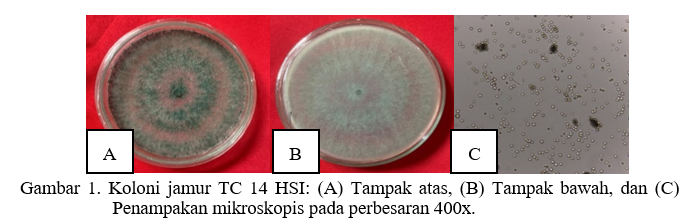
This research aims to obtain entomopathogenic fungal isolates and determine the characteristics of isolates that have the potential as biological control agents for Chilo sacchariphagus. The research was conducted in the field and at the Protection Laboratory of PT Perkebunan Nusantara VII Bunga Mayang Unit and at the Biotechnology Laboratory of the Faculty of Agriculture, University of Lampung. This research method consists of two sub-sections; the first is the exploration of entomopathogenic fungi, the second is the morphological identification of entomopathogenic fungal isolates isolated from soil suspensions and bait insects and characteristic tests consisting of growth, sporulation, viability and pathogenicity tests against C. sacchariphagus in vitro arranged in a randomized block design (RBD). From the results of the research, six fungal isolates were obtained, two isolates was able to be identified, as Trichoderma sp., and as Aspergillus sp., while the other four isolates could not be identified. Based on the growth, sporulation, spore viability, and pathogenicity tests against C. sacchariphagus that have been carried out, the six isolates have varying characteristics. The TC (Trichoderma sp.) isolate had the highest fungal colony growth, which was 8,50 cm in diameter, the highest sporulation (3,96 x 10⁷ spores/mL) was TNH3BB isolate, and the highest spore viability (100%) were belong the TNH3BB and TC (Trichoderma sp.) isolates, while the TNH2BA (Aspergillus sp.) isolate was able to cause the highest mortality to up, 93,33%.
##plugins.themes.bootstrap3.article.details##

This work is licensed under a Creative Commons Attribution-NonCommercial 4.0 International License.
References
Subasari A. 2020. Kemampuaan Purpureocillium lilavinum, Metarhizium flaviviridae, dan Penicillium sp. sebagai antagonis jamur Phytoptora capsici, endofit dan pemicu pertumbuhan tanaman lada. Skripsi. Universitas Lampung. Bandar Lampung. 94 hlm.
Ayudya DWIR., Herlinda S & Suwandi S. 2019. Insecticidal Activity of Culture Filtrates from Liquid Medium of Beauveria bassiana Isolates from South Sumatra (Indonesia) Wetland Soil Against Larvae of Spodoptera litura. Jurnal Biodiversitas. 20(8): 2101– 2109. https://doi.org/10.13057/biodiv/d200802.
Barnett HL & Hubner BB. 1998. Illustrated genera of imperfect fungi 4th edition. American Phytopathological Society Press. Minnesota. 240 hlm.
Hasyim A, Setiawati W, Hudayya A & Luthfy N. 2016. Sinergisme Jamur Entomopatogen Metarhizium anisopliae dengan Insektisida Kimia untuk Meningkatkan Mortalitas Ulat Bawang Spodoptera exigua. Jurnal Hortikultura. 26(2): 257- 266. https://doi.org/10.21082/jhort.v26n2.2016.p257-266.
Herdatiarni F, Hilmawan T & Rachmawati R. 2014. Eksplorasi Cendawan Entomopatogen Beauvaria sp. Menggunakan Serangga Umpan pada Komoditas Jagung, Tomat dan Wortel Organik di Batu, Malang. Jurnal HPT. 1(3): 1-11.
Kaya HK & Vega FE. 2012. Insect Pathology Second Edition: Scope and Basic Principles of Insect Pathology. Elsevier Inc. Amsterdam. 508 hlm.
Kementerian Pertanian. 2022. Outlook Komoditas Perkebunan Tebu. Pusat Data dan Sistem Informasi Pertanian. Jakarta. 116 hlm.
Mudjiono G. 2013. Pengelolan Hama Terpadu. UB Press. Malang. 288 hlm.
Muliasari & Ranu T. 2020. Insidensi hama dan penyakit utama tebu (Saccharum offinarum L.) di PT PG Rajawali II Jatitujuuh Majalengka. Jurnal Sains Terapan. 10(1): 40-52. https://doi.org/10.29244/jstsv.10.1.40-52.
Rahman MA, Noman MS, Maleque MA, Alam MZ, Afroz S & Chowdhury MKA. 2013. Identification and Distribution of Sugarcane Stem Borer in Bangladesh. SAARC Journal Agri. 11(2): 103-116. https://doi.org/10.3329/sja.v11i2.18406.
Respati E. 2020. Buku Outlook Komoditas Perkebunan Tebu. Pusat Data dan Sistem Informasi Pertanian. Jakarta. 117 hlm.
Sopialena. 2018. Pengendalian Hayati dengan Memberdayakan Potensi Mikroba. Mulawarman Unversity Press. Samarinda. 99 hlm.
Sugiyanto C. 2007. Permintaan Gula di Indonesia. Jurnal Ekonomi Pembangunan. 8(2): 113-127. https://doi.org/10.23917/jep.v8i2.1036.